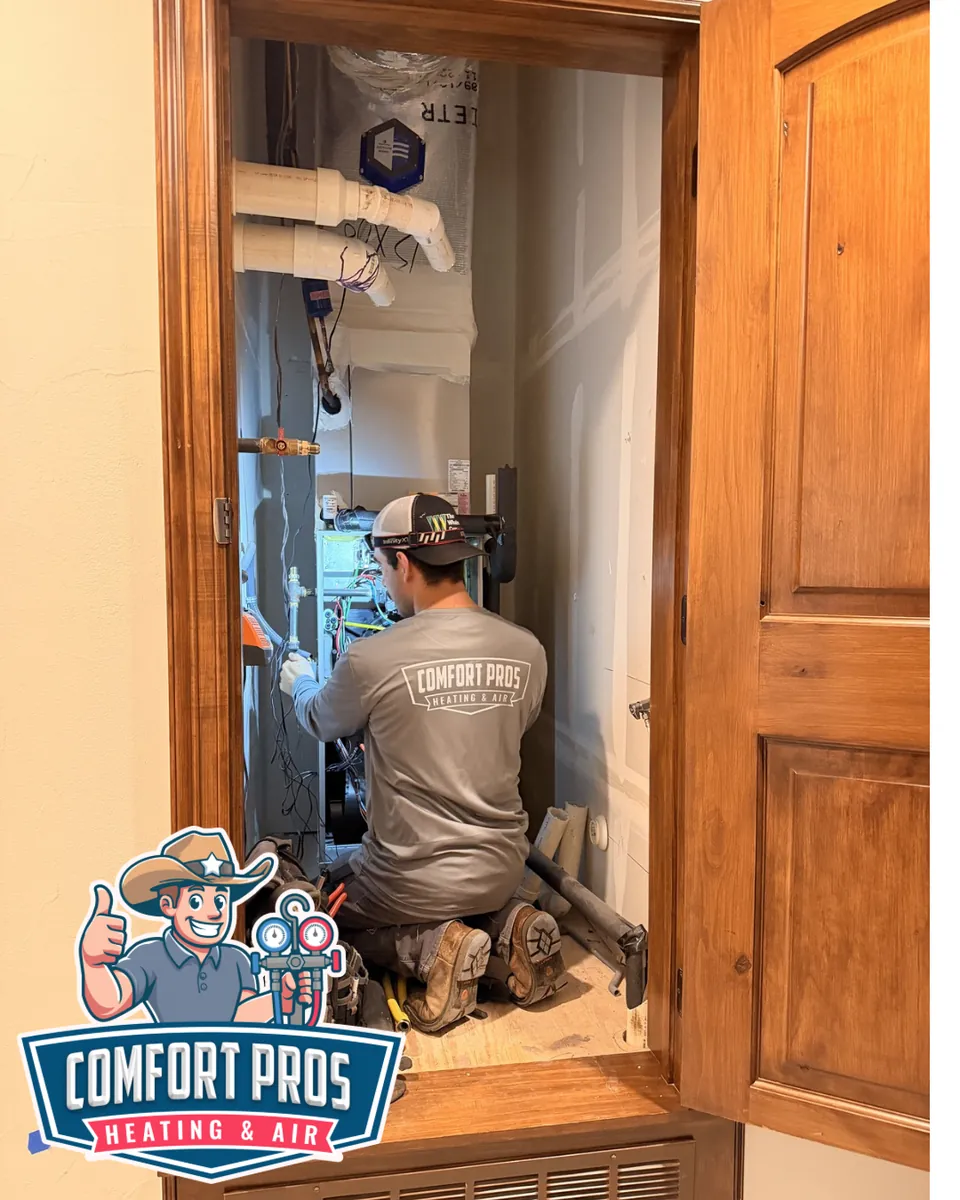
When cooling quits on a 102 degree afternoon, the question that matters is not who advertises the loudest. It is who can actually reach your house. No-cooling calls move to the front of our schedule, and we tell you on the phone whether that means today or first thing tomorrow morning.
Plenty of contractors put 24/7 on a truck and route your two in the morning call to an answering service that books you for Thursday. We would rather be straight with you. Comfort Pros runs Monday through Friday, 7 am to 6 pm, and Saturday, 8 am to 3 pm. Inside those hours, a no-cooling call in Leander gets priority over routine maintenance and non-urgent work. Outside them, leave a voicemail or send the request form and you sit near the top of the next morning's board.
That distinction matters more than it sounds. In a Leander July, the difference between a real arrival window and a vague promise is whether you sleep in your own house. When you call, we ask what the thermostat reads, whether the outdoor unit is running, and what changed. Some of those conversations end with a fix you can do yourself in ten minutes, a tripped float switch or a filter so loaded the coil iced over, and we will tell you that instead of sending a truck for it.
An unshaded Leander house gains heat fast when the system is down and it is over 100 outside. If anyone at home is an infant, over 65, pregnant, or managing a heart or respiratory condition, treat it as urgent. Call, then move everyone to the coolest room or a cooler building while you wait.
Shut the system off at the thermostat and at the breaker, then call. A scorched motor winding, a welded contactor, or overheated wiring smells like hot plastic well before anything is visible. This is one of the few HVAC faults where waiting carries real risk.
Reset it once. If it trips again, stop resetting it. That breaker is doing its job, and repeated resets into a shorted compressor or a failed capacitor can turn a modest part swap into a much larger bill.
Most two-story Leander homes carry the air handler in the attic, and a plugged condensate line backs up into the secondary pan. When that pan overflows, the ceiling below is next. Shut the system down and call, ideally before the drywall gets involved.
Switch cooling off and set the fan to on so it thaws. Ice means airflow is restricted or the charge is low, and running a frozen system is how a compressor failure gets added to the invoice. A few hours of thaw before we arrive makes the diagnosis faster.
Reach us at (512) 726-2122. We ask what the thermostat reads, whether the outdoor unit is running, and what changed. A handful of faults get solved on that call without a truck.
If we can get there today, we name the window. If the honest answer is first thing tomorrow, we say that rather than booking you and missing it. Either way you can plan around real information.
Not only the part that failed. A capacitor that burns out is often a symptom of a compressor pulling too much current, and replacing just the capacitor buys a few weeks of quiet before the same call happens again.
Written estimate, plain language, diagnostic fee applied to the repair. If it is a repair we would skip on our own house, we say so and show you the replacement math instead.
Our home base is here in Leander. When a no-cooling call comes in from Crystal Falls, Block House Creek, or anywhere off Ronald Reagan, the truck is already on this side of the toll instead of working north through afternoon traffic.
A house with no cooling in triple-digit heat outranks routine maintenance on our board. What you get is an honest window and a call if it moves, not a twelve-hour range and a hope.
Capacitors, contactors, and the common Carrier failure parts ride with the technician. Most single-visit repairs stay single-visit, which is the whole point when it is 104 outside and the house is already at 88.
The phone is faster than a form when the house is heating up. Call during business hours and we will tell you honestly where you fit on today's schedule. Outside hours, send the request and you will be near the top of tomorrow morning's board. For work that is not urgent, our standard AC repair page walks through what a normal visit looks like.